

*1911 ; † 2003

Burano Venezia No. 1
1996
Watercolour
11.8 in. x 15.7 in.
Ziethlow presents Burano as a colourful place shaped by its close relationship with the water. The brightly painted façades, small boats and their reflections come together in a cheerful, almost carefree composition. Using loose brushwork and vivid shades of red, yellow, green and blue, the artist moves away from a strictly realistic depiction of the architecture. Instead, the painting becomes a personal impression of the light, colour and atmosphere of the Venetian lagoon. Rather than capturing a single moment, the work conveys the lively spirit of a southern setting.

Code D’Azur Biot No. 305
1981
Oil on art paper
15.7 in. x 19.7 in.
Biot rises from the lush landscape of southern France in a composition dominated by strong, vibrant colours. Houses, trees and vegetation are not separated through meticulous detail, but are brought together by intense areas of colour and pronounced outlines. The rich greens, blues and reds give the painting an almost Expressionist quality. As a result, the landscape appears less as a factual view of a particular place and more as an intensified memory of warmth, light and Mediterranean vegetation. Ziethlow transforms the visible world into a vivid experience of the South.

Garmisch Partenkirchen No.0038
1975
Watercolour
14.2 in. x 18.9 in.
The impressive mountain landscape of Garmisch-Partenkirchen dominates this watercolour, forming a striking contrast with the dark fir trees and green meadows in the foreground. Against the deep blue sky, the pale mountain peaks appear particularly clear and powerful. Ziethlow avoids a highly detailed rendering of the landscape, instead reducing mountains, forests and sky to broad areas of colour. This simplification enhances the monumental quality of the Alpine scenery. The work conveys both vastness and tranquillity, presenting nature as an almost timeless space.

St. Paul No.0273
1969
Mixed media
14.0 x 18.9 in.
Lush Mediterranean vegetation dominates the foreground, opening the view towards a hilltop settlement and the intense blue of the distance. Palm trees, foliage and sweeping plant forms give the scene an almost idyllic character. Ziethlow uses nature not merely as a frame for the architecture, but makes it a central element of the composition itself. The strong colours convey a direct sense of light and warmth. Rather than presenting a purely factual landscape, the work evokes an idealised image of Mediterranean life.

Venedig No.0193
1950
Watercolour
15.4 x 19.3 in.
Gondolas and boats animate the water in front of pale Venetian façades and a distinctive campanile. Through Ziethlow’s loose watercolour technique, architecture and water seem almost to merge into one another. Rather than relying on rigid outlines, he works with flowing areas of colour, giving the scene a light and fluid quality. The reflections and transparent shades of blue and green in particular evoke Venice’s constantly changing light. The city is presented not as a static architectural ensemble, but as a living interplay of water, movement and atmosphere.

Blick auf die Erphostr. Münster No.1002
1957
Oil on paper
22.8 x 15.7 in.
In this unusually intimate composition, Ziethlow combines the closeness of a still life with a view towards the surrounding urban environment. Plants, flowers and vessels dominate the foreground, while a brighter space opens beyond them. Interior and exterior thus enter into a quiet dialogue. Muted greens, yellows and blues, together with the visible texture of the paint, give the work a calm and personal atmosphere. Unlike many of his travel scenes, this painting seems less concerned with distant places than with capturing a familiar moment of everyday observation.

Venedig No.0226
1959
Watercolour
15.7 x 19.7 in.
A large gondola in the foreground immediately attracts the viewer’s attention and forms the starting point of this lively Venetian scene. Behind it, boats, masts and buildings merge into a rhythmic network of lines and colours. Ziethlow works with rapid, confident brushstrokes that capture movement and atmosphere rather than individual detail. Water and architecture consequently lose their rigid boundaries and become part of a shared visual rhythm. Venice appears as a constantly changing environment in which water, boats and city are inseparably connected.

Paris No. 0247
1955
Watercolour
18.9 x 14.2 in.
A narrow street guides the viewer through the lively neighbourhood of Montmartre towards the distinctive silhouette of Sacré-Cœur. Ziethlow captures buildings, trees and pedestrians with loose, almost sketch-like lines. This deliberate reduction gives the scene its immediate character: Paris does not appear monumental, but rather as a lived-in and everyday city. The restrained palette is enlivened by stronger accents of colour, enhancing the fleeting atmosphere of the scene. The watercolour has the quality of a personal visual memory from a walk through the streets of the French capital.

Straßburg No. 1007
1985
Drawing
9.4 x 12.5 in.
With a few decisive lines, Ziethlow condenses the Strasbourg cityscape into a spontaneous drawn impression. Towers, rooftops and architectural forms are suggested without becoming fixed in meticulous detail. This deliberate incompleteness gives the work the feeling of an immediate observation made on location. Individual accents enliven the composition and guide the eye through its network of lines. Rather than documenting the city precisely, Ziethlow captures its characteristic silhouette and visual rhythm.

Rom, Forum Romanum No. 1017
1957
Mixed media
19.3 x 24.2 in.
The ancient columns and architectural fragments of the Roman Forum form the centre of this intensely coloured interpretation of Rome. Ziethlow appears less concerned with archaeological precision than with the interaction of historic forms, light and colour. Strong blues, yellows, reds and greens free the ruins from their heavy stone character and give them an unexpected sense of vitality. Past and present seem to merge within the composition. The Forum is presented not merely as a historic site, but as a landscape whose forms continue to have an immediate visual presence centuries later.

Rom No. 0030
1935
Mixed media on paper
19.7 in. x 15.7 in.
This early work by Ziethlow depicts a quiet Roman street scene with a tower, palm trees and pale façades shaped by southern light. Compared with his later works, the palette is more restrained and the composition more firmly based on clearly defined forms. Nevertheless, his fascination with the distinctive atmosphere of southern cities is already apparent. Architecture does not serve as a monumental backdrop, but becomes part of a quiet everyday scene. This restraint gives the work the character of a personal travel memory.

Stillleben No. 1016
1943
Mixed media on canvas
25.6 x 34.3 in.
Flowers, fruit and vessels are arranged in a classical still life and stand out vividly against the darker background. Strong reds and greens in particular give the composition warmth and visual tension. Ziethlow is less concerned with an illusionistic rendering of the individual objects than with their relationship of form, colour and surface. As a result, everyday objects are transformed into independent pictorial elements. Despite its traditional subject, the painting possesses an expressive vitality that already reveals Ziethlow’s strong interest in the emotional effect of colour.

Eze No. 329
1967
Watercolour
18.9 in. x 14.2 in.
The hilltop village of Èze appears embedded in a lush Mediterranean landscape of trees, shrubs and intense greenery. Pale houses and warm rooftops stand out vividly against the strong blues and greens of their surroundings. Ziethlow dissolves the landscape into freely applied watercolour washes and largely avoids a rigid perspective. The village consequently seems to merge with the vegetation around it. Rather than geographical precision, the work conveys an experience of light, height and Mediterranean warmth.

Hamburg No. 5
1964
Watercolour
13.8 in. x 17.7 in.
Boats, masts and harbour structures come together in this watercolour to create an atmospheric view of the Port of Hamburg. Rather than recording the technical details of the harbour, Ziethlow focuses on the interaction between water, sky and the vertical lines of ships and cranes. His loose technique conveys movement and allows the scene to almost dissolve into shifting light. The harbour therefore appears both industrial and poetic. Ziethlow discovers a distinctive rhythm of colour, water and structure within this busy working environment.

Sitges No. 9006
1963
Watercolour
11.8 in. x 15.7 in.
Colourful fishing boats rest on the beach in front of the distinctive skyline of Sitges with its church, buildings and southern vegetation. Ziethlow combines the bright blue of sky and sea with warm sandy tones and vivid accents on the boats. The individual elements are loosely arranged, giving the scene the spontaneity of a directly experienced moment. At the same time, the work radiates tranquillity and a sense of summer lightness. Sitges appears less as a tourist view than as a Mediterranean environment in which sea, work and everyday life naturally belong together.

Paris No. 9002
1960
Watercolour
15.4 in. x 19.3 in.
The powerful arches of a Parisian bridge frame the view of the Seine and give the composition a clear architectural structure. Beneath them, boats move across the water while individual figures animate the riverbank. The dark outlines of the structure contrast strikingly with the transparent blues and greens of the river. Ziethlow thus combines the weight of architecture with the lightness and movement of water. Paris appears as a city whose distinctive rhythm emerges from the interaction of stone, river and human life.

Greetsiel Nordsee No. 0008
1949
Watercolour
15.7 x 18.5 in.
Fishing boats, masts and nets define the view of the small harbour of Greetsiel, with the characteristic houses of the village rising behind them. A figure in the foreground reinforces the impression of an everyday scene observed directly from life. Ziethlow presents the harbour not as a spectacular landscape, but as a place of work and daily life on the North Sea coast. The restrained palette and loose watercolour technique give the scene a quiet, almost contemplative atmosphere. Its authenticity lies precisely in the simplicity of the moment being captured.

Venedig No. 0075
1958
Oil on canvas
23.6 x 31.5 in.
Gondolas, historic façades and elegantly dressed figures come together in a lively Venetian scene. Strong reds, blues and greens create an almost festive atmosphere, allowing both architecture and people to become essential elements of the composition. Ziethlow’s expressive style avoids meticulous detail and instead focuses on movement, colour and rhythm. As a result, the scene acquires a slightly theatrical quality, with the figures appearing almost like actors within a colourful urban setting. Venice is presented not as a quiet backdrop, but as a vibrant place of movement and encounter.

Venedig No. 0172
1955
Watercolour
15.7 x 19.7 in.
A traditional sailing boat with large reddish-brown sails dominates the foreground and gives this Venetian harbour scene its distinctive character. The strong colour of the sails provides a warm contrast to the cooler blues and greens of the water and surroundings. Ziethlow uses the boat both as a subject and as a large geometric form that structures the entire composition. His loose watercolour technique preserves a sense of movement and changing light. The work combines an observation of maritime everyday life with an almost abstract interplay of colour and shape.

Paris No. 0250
1958
Oil on paper
15.7 x 11.8 in.
A busy Parisian street leads between tall façades towards a distinctive church tower. Pedestrians, shops and signs combine to form an immediate glimpse of urban life in the 1950s. Ziethlow appears less interested in architectural precision than in the vibrant coexistence of people, buildings, movement and signs. His expressive handling of paint heightens the sense of motion and urban density. Paris is thus defined not by its famous monuments, but by the rhythm of everyday life in its streets.

Alfred Ziethlow
Biot No. 0293
1974
Watercolour
14.2 x 18.9 in.
Surrounded by lush greenery and tall cypress trees, the village of Biot rises on a hill with its pale houses and warm-coloured rooftops. The architecture seems to blend naturally into the Mediterranean vegetation. Ziethlow places intense greens, blues and reds alongside one another, heightening the visual impact of the southern French landscape. His free watercolour technique allows outlines to dissolve in places, suggesting shimmering light and summer warmth. The village therefore appears less as a sharply defined architectural structure than as part of a landscape shaped by colour and vegetation.
Alfred Ziethlow
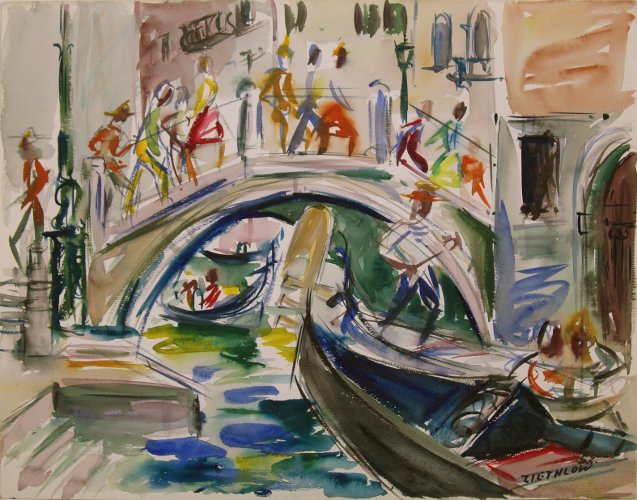
Venedig No. 9008
1953
Aquarell
40 x 50 cm
In this watercolour, Alfred Ziethlow captures the vibrant atmosphere of Venice: a curved stone bridge spans a narrow canal, with a gondola featuring a curved bow dominating the foreground. The bridge is thronged with passers-by – condensed into colourful silhouettes in just a few precise brushstrokes, in shades of orange, yellow, green and carmine red.
The loose, wet watercolour technique allows forms to flow into one another, lending the scene a sense of movement and spontaneity, whilst architectural elements – lanterns, archways, wrought-iron railings – provide a sense of stability to the composition. The cool blue and rich green of the canal water contrast with the warm earth tones of the façades, creating a lively interplay of light and shadow typical of the Venetian atmosphere.
Alfred Ziethlow
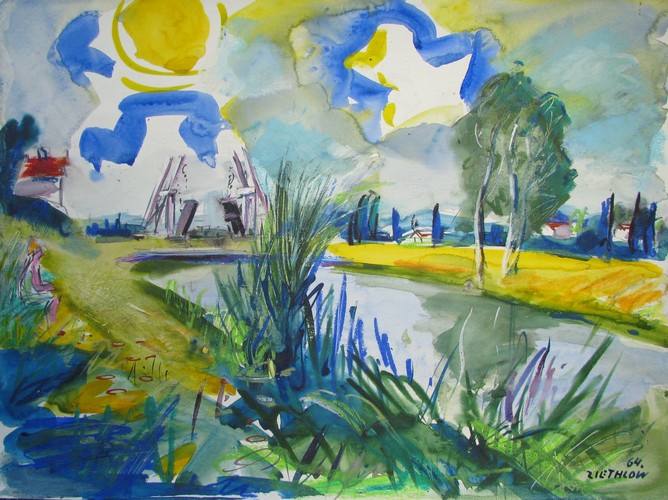
Arles No. 9011
1964
Aquarell
36 x 48 cm
Here, Alfred Ziethlow captures a sweeping view of the famous drawbridge at Arles, which Vincent van Gogh himself once immortalised in several paintings, framed by tall reeds on the riverbank in the foreground and a turbulent, vibrantly coloured sky above. Sun and clouds are rendered in bold yellows and blues as almost abstract forms, bringing the intense light of Provence to life. The bridge’s distinctive wooden structure marks the transition from nature to human intervention in the landscape, whilst a small figure on the bank savours the tranquillity of the river.
The riverbanks are rendered in warm ochre and green and, together with trees and scattered houses, are reflected in the calm waters of the Rhône. Here, Ziethlow combines loose, wet watercolour brushstrokes with impasto accents in the reeds and grasses, thereby creating a captivating interplay between delicate transparency and bold texture – a unique interpretation of a motif that, through van Gogh’s work, has become one of the most famous in art history.